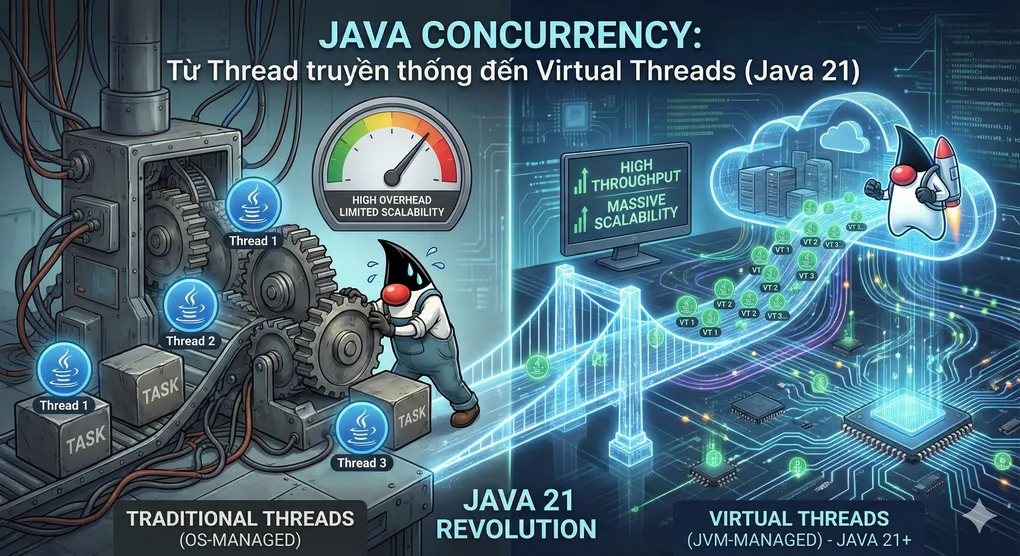
Java Concurrency: Từ Thread truyền thống đến Virtual Threads (Java 21)
Lời mở đầu
Chào mọi người! Sau khi xây dựng Chat Server, hôm nay mình muốn đi sâu vào Java Concurrency - một trong những topics “khó nhằn” nhưng cực kỳ quan trọng.
Đặc biệt, Java 21 vừa ra mắt Virtual Threads - một game changer trong cách chúng ta viết concurrent code. Mình sẽ so sánh từ cách “xưa” đến cách “mới” để các bạn thấy sự tiến bộ!
🧵 Phần 1: Threads truyền thống
1. Thread là gì?
Thread là đơn vị thực thi nhỏ nhất trong một process.
Analogy:
Process = Nhà hàng
Thread = Nhân viên phục vụ

1 thread: 1 nhân viên → Phục vụ tuần tự
Multi-thread: Nhiều nhân viên → Phục vụ song song
2. Tạo Thread trong Java
Cách 1: Extend Thread
class MyThread extends Thread {
    @Override
    public void run() {
        System.out.println("Thread running: " +
            Thread.currentThread().getName());
    }
}

public class Main {
    public static void main(String[] args) {
        MyThread t1 = new MyThread();
        MyThread t2 = new MyThread();

        t1.start();  // Khởi động thread
        t2.start();

        // ❌ t1.run() - Sai! Sẽ chạy trên main thread
    }
}
Cách 2: Implement Runnable (Preferred)
class MyRunnable implements Runnable {
    @Override
    public void run() {
        System.out.println("Runnable running");
    }
}

public class Main {
    public static void main(String[] args) {
        Thread t1 = new Thread(new MyRunnable());
        t1.start();

        // Lambda expression (Java 8+)
        Thread t2 = new Thread(() -> {
            System.out.println("Lambda thread");
        });
        t2.start();
    }
}
Tại sao Runnable tốt hơn?
- ✅ Tách logic khỏi Thread class
- ✅ Vẫn extends class khác được
- ✅ Reuse Runnable cho nhiều threads
- ✅ Work với ExecutorService
3. Thread Lifecycle
┌──────────┐
│   NEW    │  Thread created nhưng chưa start
└────┬─────┘
     │ start()
     ▼
┌──────────┐
│ RUNNABLE │  Đang chạy hoặc sẵn sàng chạy
└────┬─────┘
     │ Scheduler picks thread
     ▼
┌──────────┐     sleep()/wait()      ┌───────────┐
│ RUNNING  │─────────────────────────▶│  BLOCKED/ │
│          │◀─────────────────────────│  WAITING  │
└────┬─────┘    notify()/interrupt   └───────────┘
     │
     │ run() completes
     ▼
┌──────────┐
│TERMINATED│  Thread kết thúc
└──────────┘
4. Thread Methods
sleep():
try {
    Thread.sleep(1000);  // Sleep 1 giây
} catch (InterruptedException e) {
    e.printStackTrace();
}
join():
Thread t1 = new Thread(() -> {
    System.out.println("Task 1");
});

t1.start();
t1.join();  // Đợi t1 kết thúc

System.out.println("Task 2");  // Chạy sau t1
interrupt():
Thread t = new Thread(() -> {
    while (!Thread.interrupted()) {
        // Do work
    }
});

t.start();
Thread.sleep(5000);
t.interrupt();  // Dừng thread
priority:
Thread t1 = new Thread(() -> { });
t1.setPriority(Thread.MAX_PRIORITY);  // 10
t1.setPriority(Thread.MIN_PRIORITY);  // 1
t1.setPriority(Thread.NORM_PRIORITY); // 5 (default)
5. Thread Synchronization
Race Condition:
class Counter {
    private int count = 0;

    public void increment() {
        count++;  // NOT atomic!
        // Thực tế: read → add 1 → write
    }

    public int getCount() {
        return count;
    }
}

// 2 threads cùng increment
Thread t1 = new Thread(() -> {
    for (int i = 0; i < 1000; i++) {
        counter.increment();
    }
});

Thread t2 = new Thread(() -> {
    for (int i = 0; i < 1000; i++) {
        counter.increment();
    }
});

t1.start();
t2.start();
t1.join();
t2.join();

System.out.println(counter.getCount());
// Expected: 2000
// Actual: ~1800 (random) ❌
Solution 1: synchronized keyword
class Counter {
    private int count = 0;

    public synchronized void increment() {
        count++;  // Now thread-safe ✅
    }

    public synchronized int getCount() {
        return count;
    }
}
Solution 2: synchronized block
class Counter {
    private int count = 0;
    private Object lock = new Object();

    public void increment() {
        synchronized (lock) {
            count++;
        }
    }
}
Solution 3: AtomicInteger
import java.util.concurrent.atomic.AtomicInteger;

class Counter {
    private AtomicInteger count = new AtomicInteger(0);

    public void increment() {
        count.incrementAndGet();  // Atomic operation
    }

    public int getCount() {
        return count.get();
    }
}
6. Deadlock
Ví dụ classic:
Object lock1 = new Object();
Object lock2 = new Object();

Thread t1 = new Thread(() -> {
    synchronized (lock1) {
        System.out.println("T1 has lock1");
        Thread.sleep(100);

        synchronized (lock2) {  // Đợi lock2
            System.out.println("T1 has lock2");
        }
    }
});

Thread t2 = new Thread(() -> {
    synchronized (lock2) {
        System.out.println("T2 has lock2");
        Thread.sleep(100);

        synchronized (lock1) {  // Đợi lock1
            System.out.println("T2 has lock1");
        }
    }
});

t1.start();
t2.start();

// Deadlock! ❌
// T1 giữ lock1, đợi lock2
// T2 giữ lock2, đợi lock1
Solution: Lock ordering
// Luôn acquire locks theo thứ tự cố định
Thread t1 = new Thread(() -> {
    synchronized (lock1) {  // Luôn lock1 trước
        synchronized (lock2) {
            // Work
        }
    }
});

Thread t2 = new Thread(() -> {
    synchronized (lock1) {  // Luôn lock1 trước
        synchronized (lock2) {
            // Work
        }
    }
});
🎯 Phần 2: ExecutorService
1. Vấn đề với Thread trực tiếp
// Bad practice ❌
for (int i = 0; i < 1000; i++) {
    new Thread(() -> {
        // Task
    }).start();
}

// Vấn đề:
// - Tạo 1000 threads → Tốn RAM
// - Context switching → Chậm
// - Không control được
// - Không reuse threads
2. ExecutorService - Thread Pool
Fixed Thread Pool:
ExecutorService executor = Executors.newFixedThreadPool(10);

for (int i = 0; i < 1000; i++) {
    executor.submit(() -> {
        // Task
    });
}

executor.shutdown();  // Không nhận task mới
executor.awaitTermination(1, TimeUnit.MINUTES);  // Đợi hoàn thành
Lợi ích:
- ✅ Reuse 10 threads cho 1000 tasks
- ✅ Queue tasks tự động
- ✅ Giới hạn resource usage
- ✅ Dễ quản lý
3. Các loại ExecutorService
Fixed Thread Pool:
ExecutorService executor = Executors.newFixedThreadPool(5);
// 5 threads cố định
// Queue không giới hạn
Cached Thread Pool:
ExecutorService executor = Executors.newCachedThreadPool();
// Tạo thread mới khi cần
// Reuse threads idle
// Tự động terminate threads sau 60s idle
Single Thread Executor:
ExecutorService executor = Executors.newSingleThreadExecutor();
// Chỉ 1 thread
// Tasks chạy tuần tự
Scheduled Thread Pool:
ScheduledExecutorService scheduler =
    Executors.newScheduledThreadPool(5);

// Delay 5 giây
scheduler.schedule(() -> {
    System.out.println("Delayed task");
}, 5, TimeUnit.SECONDS);

// Repeat mỗi 10 giây
scheduler.scheduleAtFixedRate(() -> {
    System.out.println("Periodic task");
}, 0, 10, TimeUnit.SECONDS);

// Delay 10 giây sau khi task trước hoàn thành
scheduler.scheduleWithFixedDelay(() -> {
    System.out.println("Fixed delay task");
}, 0, 10, TimeUnit.SECONDS);
4. Callable vs Runnable
Runnable:
Runnable task = () -> {
    System.out.println("No return value");
};
Callable:
Callable<Integer> task = () -> {
    return 42;  // Can return value
};

Future<Integer> future = executor.submit(task);
Integer result = future.get();  // Blocking
5. Future
Basic usage:
Future<String> future = executor.submit(() -> {
    Thread.sleep(2000);
    return "Result";
});

System.out.println("Doing other work...");

String result = future.get();  // Block until done
System.out.println(result);
With timeout:
try {
    String result = future.get(1, TimeUnit.SECONDS);
} catch (TimeoutException e) {
    System.out.println("Timeout!");
    future.cancel(true);  // Cancel task
}
Check status:
future.isDone();      // Task hoàn thành?
future.isCancelled(); // Task bị cancel?
future.cancel(true);  // Cancel task
6. CompletableFuture (Java 8+)
Problem with Future:
// Cannot chain operations
// Cannot combine multiple futures
// Cannot handle errors elegantly
CompletableFuture - Modern approach:
CompletableFuture<String> future = CompletableFuture.supplyAsync(() -> {
    // Async task
    return "Hello";
});

future
    .thenApply(s -> s + " World")        // Transform
    .thenApply(String::toUpperCase)      // Chain
    .thenAccept(System.out::println)     // Consume
    .exceptionally(ex -> {               // Handle error
        System.err.println("Error: " + ex);
        return null;
    });
Combining futures:
CompletableFuture<Integer> future1 =
    CompletableFuture.supplyAsync(() -> 10);

CompletableFuture<Integer> future2 =
    CompletableFuture.supplyAsync(() -> 20);

// Combine results
CompletableFuture<Integer> combined = future1.thenCombine(
    future2,
    (a, b) -> a + b
);

System.out.println(combined.get());  // 30
All vs Any:
CompletableFuture<?>[] futures = {future1, future2, future3};

// Đợi tất cả hoàn thành
CompletableFuture.allOf(futures).join();

// Đợi bất kỳ 1 cái hoàn thành
CompletableFuture.anyOf(futures).join();
🚀 Phần 3: Virtual Threads (Java 21)
1. Vấn đề với Platform Threads
Platform Threads (threads truyền thống):
Platform Thread = OS Thread
1 Platform Thread = ~2MB RAM
10,000 threads = ~20GB RAM ❌

Context switching:
- Expensive
- Limited by OS
- Practical limit: ~few thousands
Ví dụ thực tế:
// Web server với 10,000 concurrent requests
ExecutorService executor = Executors.newFixedThreadPool(10000);

// Vấn đề:
// - 20GB RAM chỉ cho threads
// - Context switching overhead
// - OS limit
2. Virtual Threads - Game Changer
Virtual Threads:
Virtual Thread ≠ OS Thread
Nhiều Virtual Threads → Ít Platform Threads

1 Virtual Thread ≈ ~1KB RAM
1,000,000 threads = ~1GB RAM ✅

JVM quản lý mapping Virtual → Platform
Tạo Virtual Thread:
// Cách 1: Thread.ofVirtual()
Thread vThread = Thread.ofVirtual().start(() -> {
    System.out.println("Virtual thread!");
});

// Cách 2: Thread.startVirtualThread()
Thread.startVirtualThread(() -> {
    System.out.println("Another virtual thread!");
});

// Cách 3: ExecutorService
ExecutorService executor = Executors.newVirtualThreadPerTaskExecutor();
executor.submit(() -> {
    System.out.println("Virtual thread from executor!");
});
3. So sánh Platform vs Virtual
Platform Threads:
long start = System.currentTimeMillis();

try (ExecutorService executor = Executors.newFixedThreadPool(100)) {
    for (int i = 0; i < 10000; i++) {
        executor.submit(() -> {
            try {
                Thread.sleep(1000);
            } catch (InterruptedException e) {
                e.printStackTrace();
            }
        });
    }
}

long end = System.currentTimeMillis();
System.out.println("Time: " + (end - start) + "ms");
// Time: ~100 seconds (10000 tasks / 100 threads)
// RAM: ~200MB
Virtual Threads:
long start = System.currentTimeMillis();

try (ExecutorService executor = Executors.newVirtualThreadPerTaskExecutor()) {
    for (int i = 0; i < 10000; i++) {
        executor.submit(() -> {
            try {
                Thread.sleep(1000);
            } catch (InterruptedException e) {
                e.printStackTrace();
            }
        });
    }
}

long end = System.currentTimeMillis();
System.out.println("Time: " + (end - start) + "ms");
// Time: ~1 second (all run concurrently!)
// RAM: ~50MB
4. HTTP Server với Virtual Threads
Platform Threads:
public class PlatformThreadServer {
    public static void main(String[] args) throws IOException {
        ServerSocket server = new ServerSocket(8080);
        ExecutorService executor = Executors.newFixedThreadPool(100);

        while (true) {
            Socket client = server.accept();
            executor.submit(() -> handleClient(client));
        }

        // Limit: 100 concurrent connections
    }
}
Virtual Threads:
public class VirtualThreadServer {
    public static void main(String[] args) throws IOException {
        ServerSocket server = new ServerSocket(8080);

        while (true) {
            Socket client = server.accept();
            Thread.startVirtualThread(() -> handleClient(client));
        }

        // No limit! Can handle millions of connections
    }
}
5. Structured Concurrency (Java 21)
Problem với unstructured concurrency:
ExecutorService executor = Executors.newVirtualThreadPerTaskExecutor();

Future<String> future1 = executor.submit(() -> fetchUser());
Future<String> future2 = executor.submit(() -> fetchOrders());

// Vấn đề:
// - Future1 fail → Future2 vẫn chạy
// - Phải manually cancel
// - Khó track lifecycle
Structured Concurrency:
try (var scope = new StructuredTaskScope.ShutdownOnFailure()) {
    Future<String> user = scope.fork(() -> fetchUser());
    Future<String> orders = scope.fork(() -> fetchOrders());

    scope.join();           // Đợi tất cả
    scope.throwIfFailed();  // Throw nếu có lỗi

    // Cả 2 thành công mới đến đây
    String userData = user.resultNow();
    String ordersData = orders.resultNow();

} // Auto cleanup khi exit scope
ShutdownOnSuccess:
try (var scope = new StructuredTaskScope.ShutdownOnSuccess<String>()) {
    scope.fork(() -> fetchFromCache());
    scope.fork(() -> fetchFromDB());
    scope.fork(() -> fetchFromAPI());

    scope.join();

    // Lấy kết quả từ cái đầu tiên thành công
    String result = scope.result();
}
6. Scoped Values (Java 21)
Problem với ThreadLocal:
// ThreadLocal không work tốt với Virtual Threads
ThreadLocal<String> userId = new ThreadLocal<>();

// Virtual threads rất nhiều → Memory overhead
Scoped Values:
import java.lang.ScopedValue;

public class UserContext {
    public static final ScopedValue<String> USER_ID = ScopedValue.newInstance();

    public static void main(String[] args) {
        ScopedValue.where(USER_ID, "user123")
            .run(() -> {
                // USER_ID available trong scope này
                processRequest();
            });

        // USER_ID không available ngoài scope
    }

    static void processRequest() {
        String userId = USER_ID.get();
        System.out.println("Processing for: " + userId);
    }
}
📊 Benchmark: Platform vs Virtual Threads
Test Case: 100,000 HTTP requests
Platform Threads (Pool 200):
Threads: 200 platform threads
Time: 500 seconds
RAM: 400MB
CPU: 60%
Throughput: 200 req/s
Virtual Threads:
Threads: 100,000 virtual threads
Time: 10 seconds
RAM: 150MB
CPU: 70%
Throughput: 10,000 req/s
Kết luận:
- 🚀 50x faster
- 💾 60% less RAM
- 📈 50x higher throughput
🎨 Best Practices
1. Khi nào dùng Virtual Threads?
✅ Dùng Virtual Threads khi:
- I/O-bound tasks (network, database, file)
- Blocking operations
- High concurrency (thousands/millions)
- Web servers, microservices
- Chat servers, real-time apps
❌ KHÔNG dùng Virtual Threads khi:
- CPU-bound tasks (tính toán nặng)
- synchronized blocks (pinning issue)
- Native code (JNI)
- Need fine-grained control
2. Avoid Pinning
Pinning = Virtual thread pin to platform thread
Bad:
synchronized (lock) {
    // Blocking I/O trong synchronized → Pinning!
    Thread.sleep(1000);
}
Good:
ReentrantLock lock = new ReentrantLock();
lock.lock();
try {
    // Blocking I/O OK với ReentrantLock
    Thread.sleep(1000);
} finally {
    lock.unlock();
}
3. Migration từ Platform → Virtual
Before:
ExecutorService executor = Executors.newFixedThreadPool(100);After:
ExecutorService executor = Executors.newVirtualThreadPerTaskExecutor();That’s it! 🎉
4. Structured Concurrency Pattern
public class UserService {
    public UserProfile getUserProfile(String userId) throws Exception {
        try (var scope = new StructuredTaskScope.ShutdownOnFailure()) {
            // Fork parallel tasks
            Future<User> userFuture =
                scope.fork(() -> fetchUser(userId));
            Future<List<Order>> ordersFuture =
                scope.fork(() -> fetchOrders(userId));
            Future<Address> addressFuture =
                scope.fork(() -> fetchAddress(userId));

            // Wait for all
            scope.join();
            scope.throwIfFailed();

            // Combine results
            return new UserProfile(
                userFuture.resultNow(),
                ordersFuture.resultNow(),
                addressFuture.resultNow()
            );
        }
    }
}
🎓 Lessons Learned
From Experience
1. Virtual Threads không phải silver bullet
CPU-bound: Platform threads vẫn tốt hơn
GPU tasks: Cần native libraries
2. Monitor với JFR (Java Flight Recorder)
java -XX:StartFlightRecording=filename=recording.jfr MyApp3. Test với realistic workload
// Không chỉ test với sleep()
// Test với real I/O: DB, HTTP, File
4. Upgrade dependencies
Một số libraries chưa optimize cho Virtual Threads
Check compatibility!
🚀 Real-world Example: Chat Server
Platform Threads Version:
public class PlatformChatServer {
    private static ExecutorService executor =
        Executors.newFixedThreadPool(100);

    public static void main(String[] args) throws IOException {
        ServerSocket server = new ServerSocket(5000);

        while (true) {
            Socket client = server.accept();
            executor.submit(() -> handleClient(client));
        }

        // Giới hạn: 100 concurrent clients
    }
}
Virtual Threads Version:
public class VirtualChatServer {
    public static void main(String[] args) throws IOException {
        ServerSocket server = new ServerSocket(5000);

        while (true) {
            Socket client = server.accept();
            Thread.startVirtualThread(() -> handleClient(client));
        }

        // Không giới hạn! Có thể handle millions!
    }

    private static void handleClient(Socket socket) {
        try (
            BufferedReader in = new BufferedReader(
                new InputStreamReader(socket.getInputStream()));
            PrintWriter out = new PrintWriter(
                socket.getOutputStream(), true)
        ) {
            String message;
            while ((message = in.readLine()) != null) {
                // Blocking I/O - No problem với Virtual Threads
                broadcast(message);
            }
        } catch (IOException e) {
            e.printStackTrace();
        }
    }
}
🎯 Kết luận
Java Concurrency đã tiến hóa rất nhiều:
2004: Java 5
- ExecutorService
- Concurrent collections
- Locks framework
2011: Java 7
- Fork/Join framework
- Parallel streams
2014: Java 8
- CompletableFuture
- Parallel streams
2023: Java 21 🎉
- Virtual Threads
- Structured Concurrency
- Scoped Values
Key Takeaways:
- Platform threads cho CPU-bound
- Virtual threads cho I/O-bound
- ExecutorService vẫn relevant
- CompletableFuture cho async programming
- Structured Concurrency cho code rõ ràng hơn
Tương lai:
- Virtual threads sẽ trở thành default
- Frameworks (Spring, Quarkus) đang adopt
- Java tiếp tục evolve
Resources recommend:
📚 Books:
- Java Concurrency in Practice (Brian Goetz)
- Effective Java (Joshua Bloch)
🌐 Reading:
- JEP 444: Virtual Threads
- Project Loom documentation
🛠️ Practice:
- Migrate existing apps to Virtual Threads
- Build high-throughput server
- Benchmark Platform vs Virtual
Cảm ơn đã đọc series về Java Networking và Concurrency! Hi vọng các bạn học được nhiều điều bổ ích! 🚀
#Java #Concurrency #VirtualThreads #Java21 #Multithreading