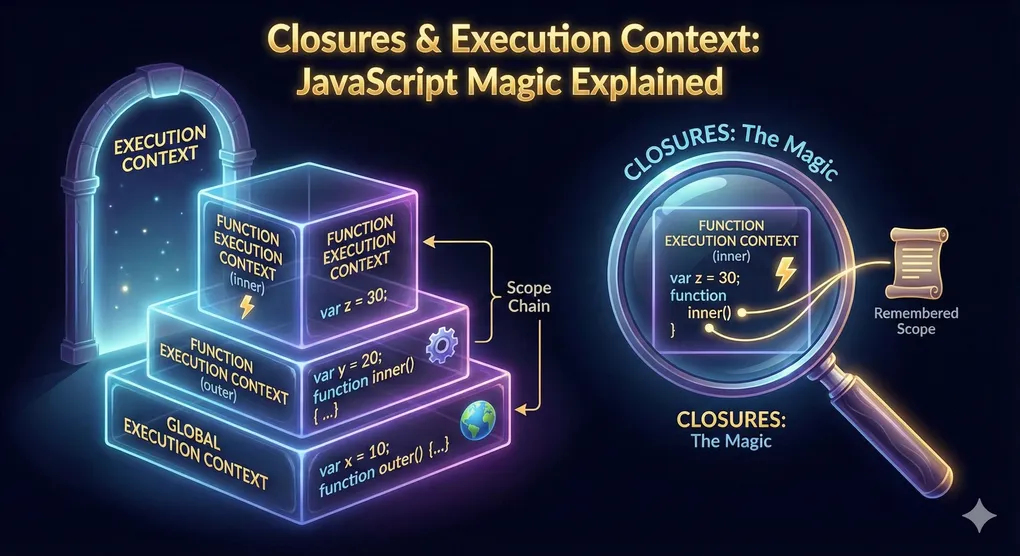
Closures & Execution Context: JavaScript Magic Explained
Lời mở đầu: Function có “trí nhớ”?
Bạn có bao giờ tự hỏi tại sao code này hoạt động?
function createCounter() {
  let count = 0;
  return function() {
    return ++count;
  };
}

const counter = createCounter();
console.log(counter()); // 1
console.log(counter()); // 2
console.log(counter()); // 3
count đã được khai báo trong createCounter, hàm đó đã chạy xong và return rồi. Vậy tại sao inner function vẫn “nhớ” được count?
Đây là magic của Closures - một trong những concepts quan trọng nhất và dễ hiểu sai nhất trong JavaScript. Hôm nay, chúng ta sẽ:
- Hiểu Execution Context và Call Stack
- Phân biệt Lexical Scope vs Dynamic Scope
- Master Closures từ góc độ kỹ sư
- Tránh memory leaks liên quan đến closures
- Apply vào real-world use cases
Let’s dive deep! 🚀
1. Execution Context: Nơi Code “sống”
1.1. Execution Context là gì?
Execution Context (EC) là môi trường mà JavaScript code được execute. Mỗi khi một function được gọi, JavaScript engine tạo một EC mới.
3 loại Execution Context:
-
Global Execution Context (GEC)
- Được tạo khi script chạy lần đầu
- Chỉ có 1 GEC trong toàn bộ program
- Tạo
windowobject (browser) hoặcglobalobject (Node.js) this=window(strict mode:undefined)
-
Function Execution Context (FEC)
- Tạo mỗi khi function được invoke
- Mỗi function call = 1 FEC mới
- Có riêng
this,arguments, và local variables
-
Eval Execution Context
- Tạo bởi
eval()function - Ít dùng, không recommend (security issues)
- Tạo bởi
1.2. Execution Context có gì bên trong?
Mỗi EC có 3 components chính:
1. Variable Environment (VE)
- Chứa
vardeclarations - Function declarations
- Arguments object (cho functions)
2. Lexical Environment (LE)
- Chứa
let,constdeclarations - Reference đến outer environment (parent scope)
3. this Binding
- Value của
thiskeyword
Structure:
ExecutionContext = {
  VariableEnvironment: {
    environmentRecord: {
      // var declarations, function declarations
    },
    outer: <reference to parent VE>
  },

  LexicalEnvironment: {
    environmentRecord: {
      // let, const declarations
    },
    outer: <reference to parent LE>
  },

  ThisBinding: <value of this>
}
1.3. Execution Context Lifecycle
Mỗi EC trải qua 2 phases:
Phase 1: Creation Phase
-
Tạo Variable Object/Environment
- Scan code để tìm declarations
- Function declarations được hoisted đầy đủ
varvariables được hoisted với valueundefinedlet/constvào Temporal Dead Zone (TDZ)
-
Tạo Scope Chain
- Link đến parent scope qua
outerreference
- Link đến parent scope qua
-
Determine
thisvalue- Phụ thuộc vào cách function được call
Phase 2: Execution Phase
- Execute code line by line
- Assign values cho variables
- Execute functions
Example:
console.log(foo); // undefined (hoisted var)
console.log(bar); // ReferenceError: Cannot access 'bar' before initialization (TDZ)

var foo = 'hello';
let bar = 'world';

function greet() {
  console.log('Hi!');
}

greet(); // Hi!
Creation Phase:
GlobalEC = {
  VariableEnvironment: {
    foo: undefined,        // var hoisted
    greet: <function>      // function hoisted
  },
  LexicalEnvironment: {
    bar: <uninitialized>   // TDZ
  }
}
Execution Phase:
foo → 'hello'
bar → 'world'
greet() executes
2. Call Stack: Quản lý Execution Contexts
2.1. Call Stack là gì?
Call Stack (hay Execution Stack) là LIFO (Last In, First Out) data structure để track execution contexts.
Hoạt động:
1. Script starts → Push GlobalEC lên stack
2. Function called → Push FEC lên stack
3. Function returns → Pop FEC khỏi stack
4. Script ends → Pop GlobalEC
Visual:
function first() {
  console.log('First');
  second();
  console.log('First again');
}

function second() {
  console.log('Second');
  third();
  console.log('Second again');
}

function third() {
  console.log('Third');
}

first();
Call Stack Evolution:
Step 1: Script starts
┌─────────────┐
│  GlobalEC   │
└─────────────┘

Step 2: first() called
┌─────────────┐
│  first EC   │
├─────────────┤
│  GlobalEC   │
└─────────────┘

Step 3: second() called (inside first)
┌─────────────┐
│  second EC  │
├─────────────┤
│  first EC   │
├─────────────┤
│  GlobalEC   │
└─────────────┘

Step 4: third() called (inside second)
┌─────────────┐
│  third EC   │
├─────────────┤
│  second EC  │
├─────────────┤
│  first EC   │
├─────────────┤
│  GlobalEC   │
└─────────────┘

Step 5: third() returns
┌─────────────┐
│  second EC  │
├─────────────┤
│  first EC   │
├─────────────┤
│  GlobalEC   │
└─────────────┘

Step 6: second() returns
┌─────────────┐
│  first EC   │
├─────────────┤
│  GlobalEC   │
└─────────────┘

Step 7: first() returns
┌─────────────┐
│  GlobalEC   │
└─────────────┘
Output:
First
Second
Third
Second again
First again
2.2. Stack Overflow
Call Stack có giới hạn size (browser: ~10,000 frames, Node.js: ~15,000).
Infinite recursion:
function recurse() {
  recurse(); // No base case!
}

recurse(); // Uncaught RangeError: Maximum call stack size exceeded
Stack khi overflow:
┌─────────────┐
│  recurse EC │ ← 15000th call
├─────────────┤
│  recurse EC │
├─────────────┤
│  recurse EC │
├─────────────┤
│     ...     │
├─────────────┤
│  GlobalEC   │
└─────────────┘
Stack Overflow! 💥
3. Lexical Scope: “Nơi sinh ra” quyết định
3.1. Lexical Scope vs Dynamic Scope
Lexical Scope (hay Static Scope):
- Scope được xác định tại thời điểm viết code (where function is defined)
- JavaScript dùng lexical scope
Dynamic Scope:
- Scope được xác định tại thời điểm chạy code (where function is called)
- Bash, Perl dùng dynamic scope
Example minh họa:
const name = 'Global';

function outer() {
  const name = 'Outer';

  function inner() {
    console.log(name); // Lexical: 'Outer', Dynamic: depends on caller
  }

  return inner;
}

const fn = outer();
fn(); // Lexical scope → 'Outer'

// Nếu JS dùng dynamic scope:
function anotherContext() {
  const name = 'Another';
  fn(); // Dynamic scope → 'Another'
}
Trong JavaScript (Lexical):
innerđược define bên trongouterinnernhìn thấy variables củaouter- Không quan trọng
innerđược call ở đâu
3.2. Scope Chain
Scope Chain là chuỗi các outer references từ inner scope đến global scope.
Lookup process:
const a = 'global';

function outer() {
  const b = 'outer';

  function inner() {
    const c = 'inner';
    console.log(a); // Where is 'a'?
  }

  inner();
}

outer();
Scope Chain:
inner scope: { c: 'inner' }
       ↓ (outer reference)
outer scope: { b: 'outer' }
       ↓ (outer reference)
global scope: { a: 'global' }
Variable lookup cho a:
- Check inner scope →
anot found - Check outer scope (via outer reference) →
anot found - Check global scope →
afound! → Return'global'
Nếu không tìm thấy ở global:
console.log(notExist); // ReferenceError: notExist is not defined3.3. Block Scope vs Function Scope
Function Scope (var):
function test() {
  if (true) {
    var x = 10;
  }
  console.log(x); // 10 (var không có block scope)
}
Block Scope (let/const):
function test() {
  if (true) {
    let y = 20;
    const z = 30;
  }
  console.log(y); // ReferenceError (let có block scope)
}
Scope boundaries:
Function { }  ← var, let, const scoped
Block { }     ← let, const scoped only
4. Closures: The Magic Revealed
4.1. Closure là gì?
Closure = Function + Lexical Environment (nơi function được define)
Định nghĩa chính xác:
A closure is a function that has access to variables in its outer (enclosing) lexical scope, even after the outer function has returned.
Key insight: Function “nhớ” variables từ nơi nó được sinh ra, không phải nơi nó được gọi.
4.2. Closure Creation
function outer() {
  const message = 'Hello';

  function inner() {
    console.log(message); // Access outer variable
  }

  return inner;
}

const myClosure = outer();
myClosure(); // 'Hello'
Điều gì xảy ra?
Step 1: outer() được call
Call Stack:
┌─────────────┐
│  outer EC   │
│  message:'Hello'
│  inner: <fn>│
├─────────────┤
│  GlobalEC   │
└─────────────┘
Step 2: outer() returns inner function
Call Stack:
┌─────────────┐
│  GlobalEC   │
│ myClosure: <inner fn>
└─────────────┘

outer EC được pop khỏi stack,
NHƯNG message vẫn còn trong memory!
Step 3: myClosure() (aka inner()) được call
Call Stack:
┌─────────────┐
│  inner EC   │
│  [[Scope]]: → {message: 'Hello'} (closure!)
├─────────────┤
│  GlobalEC   │
└─────────────┘
Closure Environment:
inner function object = {
  code: function() { console.log(message); },
  [[Scope]]: {
    message: 'Hello'  ← Captured from outer!
  }
}
inner có reference đến outer’s lexical environment, nên message không bị garbage collected.
4.3. Multiple Closures
function createCounter() {
  let count = 0;

  return {
    increment: function() { return ++count; },
    decrement: function() { return --count; },
    getCount: function() { return count; }
  };
}

const counter1 = createCounter();
console.log(counter1.increment()); // 1
console.log(counter1.increment()); // 2

const counter2 = createCounter();
console.log(counter2.increment()); // 1 (independent!)
Mỗi call tạo closure riêng:
counter1 closure: { count: 2 }
counter2 closure: { count: 1 }
3 methods (increment, decrement, getCount) trong cùng counter share cùng closure environment.
4.4. Closures trong Loops (Classic Bug)
Vấn đề:
for (var i = 0; i < 3; i++) {
  setTimeout(function() {
    console.log(i);
  }, 1000);
}
// Output: 3, 3, 3 (NOT 0, 1, 2!)
Tại sao?
var ilà function-scoped (global scope)- 3 setTimeout callbacks share cùng
i - Khi callbacks chạy (sau 1s), loop đã chạy xong →
i = 3
Visualization:
Loop ends → i = 3

Callback 1: console.log(i) → 3 (same i)
Callback 2: console.log(i) → 3 (same i)
Callback 3: console.log(i) → 3 (same i)
Solution 1: Dùng let (block scope)
for (let i = 0; i < 3; i++) {
  setTimeout(function() {
    console.log(i);
  }, 1000);
}
// Output: 0, 1, 2 ✓
Mỗi iteration tạo new block scope với riêng i.
Solution 2: IIFE (Immediately Invoked Function Expression)
for (var i = 0; i < 3; i++) {
  (function(j) {
    setTimeout(function() {
      console.log(j);
    }, 1000);
  })(i);
}
// Output: 0, 1, 2 ✓
IIFE tạo new function scope cho mỗi iteration, capture i as parameter j.
5. Practical Use Cases
5.1. Data Privacy / Encapsulation
function createBankAccount(initialBalance) {
  let balance = initialBalance; // Private variable

  return {
    deposit(amount) {
      if (amount > 0) {
        balance += amount;
        return balance;
      }
    },

    withdraw(amount) {
      if (amount > 0 && amount <= balance) {
        balance -= amount;
        return balance;
      }
      return 'Insufficient funds';
    },

    getBalance() {
      return balance;
    }
  };
}

const account = createBankAccount(1000);
console.log(account.getBalance()); // 1000
account.deposit(500);              // 1500
console.log(account.balance);      // undefined (private!)
Không thể trực tiếp access balance → True encapsulation!
5.2. Function Factory / Partial Application
function multiply(a) {
  return function(b) {
    return a * b;
  };
}

const double = multiply(2);
const triple = multiply(3);

console.log(double(5));  // 10
console.log(triple(5));  // 15
Currying example:
function add(a) {
  return function(b) {
    return function(c) {
      return a + b + c;
    };
  };
}

console.log(add(1)(2)(3)); // 6

// Or with arrow functions:
const addArrow = a => b => c => a + b + c;
5.3. Event Handlers với Context
function setupButton(buttonId, message) {
  const button = document.getElementById(buttonId);

  button.addEventListener('click', function() {
    alert(message); // Closure over 'message'
  });
}

setupButton('btn1', 'Button 1 clicked!');
setupButton('btn2', 'Button 2 clicked!');
Mỗi handler nhớ riêng message của nó.
5.4. Memoization (Caching)
function memoize(fn) {
  const cache = {}; // Closure over cache

  return function(...args) {
    const key = JSON.stringify(args);

    if (key in cache) {
      console.log('From cache');
      return cache[key];
    }

    console.log('Computing...');
    const result = fn(...args);
    cache[key] = result;
    return result;
  };
}

const slowSquare = n => {
  // Simulate slow computation
  for (let i = 0; i < 1e9; i++) {}
  return n * n;
};

const fastSquare = memoize(slowSquare);

console.log(fastSquare(5)); // Computing... 25
console.log(fastSquare(5)); // From cache 25
cache được preserve qua mỗi call → Perfect for caching!
5.5. Module Pattern
const Calculator = (function() {
  // Private variables
  let history = [];

  // Private function
  function log(operation) {
    history.push(operation);
  }

  // Public API
  return {
    add(a, b) {
      const result = a + b;
      log(`${a} + ${b} = ${result}`);
      return result;
    },

    getHistory() {
      return [...history]; // Return copy
    },

    clearHistory() {
      history = [];
    }
  };
})();

Calculator.add(2, 3);     // 5
Calculator.add(5, 7);     // 12
console.log(Calculator.getHistory()); // ['2 + 3 = 5', '5 + 7 = 12']
console.log(Calculator.history);      // undefined (private!)
Module pattern cho phép:
- Private state (
history) - Private helpers (
log) - Public API (
add,getHistory)
6. Common Pitfalls
6.1. Memory Leaks
Problem: Closures giữ reference đến outer variables → Ngăn garbage collection
function createHugeClosure() {
  const hugeArray = new Array(1000000).fill('data');

  return function() {
    console.log(hugeArray[0]); // Keeps entire hugeArray in memory!
  };
}

const closures = [];
for (let i = 0; i < 100; i++) {
  closures.push(createHugeClosure());
}
// Memory: 100 * 1MB = 100MB kept in memory!
Solution: Chỉ capture data cần thiết
function createSmallClosure() {
  const hugeArray = new Array(1000000).fill('data');
  const firstElement = hugeArray[0]; // Extract needed data

  return function() {
    console.log(firstElement); // Only keeps 1 string, not entire array
  };
}
6.2. this trong Closures
Problem: this không được captured như variables thường
const obj = {
  name: 'Object',

  printName: function() {
    setTimeout(function() {
      console.log(this.name); // undefined (this = window/global)
    }, 1000);
  }
};

obj.printName();
Solution 1: Arrow function (lexical this)
printName: function() {
  setTimeout(() => {
    console.log(this.name); // 'Object' ✓
  }, 1000);
}
Solution 2: Store this reference
printName: function() {
  const self = this;
  setTimeout(function() {
    console.log(self.name); // 'Object' ✓
  }, 1000);
}
6.3. Closure trong Class Methods
class Counter {
  constructor() {
    this.count = 0;
  }

  increment() {
    this.count++;
  }

  setupButton() {
    document.getElementById('btn').addEventListener('click', this.increment);
    // Bug: 'this' will be button element, not Counter instance!
  }
}
Solution: Bind hoặc arrow function
setupButton() {
  // Option 1: bind
  document.getElementById('btn')
    .addEventListener('click', this.increment.bind(this));

  // Option 2: arrow function
  document.getElementById('btn')
    .addEventListener('click', () => this.increment());
}

// Option 3: Class field arrow function
class Counter {
  count = 0;

  increment = () => {
    this.count++;
  }
}
7. Performance Considerations
7.1. Closure Creation Cost
Mỗi closure = Memory overhead (closure environment + function object).
Bad: Tạo closure trong loop
const buttons = document.querySelectorAll('.button');

buttons.forEach(button => {
  button.addEventListener('click', function() {
    // New closure cho MỖI button
    console.log('Clicked!');
  });
});
Better: Reuse function
function handleClick() {
  console.log('Clicked!');
}

buttons.forEach(button => {
  button.addEventListener('click', handleClick);
});
7.2. Garbage Collection
Closures được GC khi:
- Không còn reference đến closure function
- Outer function’s environment không còn ai reference
function outer() {
  const data = new Array(1000000);

  return function inner() {
    console.log(data.length);
  };
}

let closure = outer();
// 'data' vẫn trong memory (closure reference)

closure = null;
// Giờ 'data' có thể được GC
8. Interview Questions Perspective
8.1. Classic Questions
Q: Closure là gì? Cho ví dụ.
A: Closure là function có access đến variables trong outer scope, ngay cả sau khi outer function đã return. Example: Counter pattern.
Q: Phân biệt var, let, const trong context của closures.
A:
var: Function-scoped, có thể gây bug trong looplet/const: Block-scoped, mỗi iteration tạo new binding
Q: Giải thích this trong closures.
A: Regular functions không capture this lexically. Arrow functions thì có (lexical this).
8.2. Advanced Questions
Q: Memory leak có thể xảy ra như thế nào với closures?
A: Closure giữ reference đến entire outer scope, kể cả variables không dùng đến. Solution: Extract only needed data, hoặc explicitly null out references.
Q: Performance implications của closures?
A: Memory overhead cho mỗi closure environment. Avoid tạo closures trong hot paths (loops, recursive calls).
9. Kết luận: Master the Fundamentals
Key Takeaways:
✅ Execution Context - Môi trường code execute, có Variable/Lexical Environment + this
✅ Call Stack - LIFO structure tracking ECs
✅ Lexical Scope - Scope xác định tại nơi function defined, không phải called
✅ Scope Chain - Lookup qua outer references
✅ Closures - Function + Lexical Environment, “nhớ” outer variables
✅ Use Cases - Data privacy, factory functions, memoization, module pattern
✅ Pitfalls - Memory leaks, this binding, loop bugs
✅ Performance - Closure creation cost, GC implications
Best Practices:
- Hiểu lexical scope - Biết function “nhìn thấy” variables nào
- Dùng
let/const- Tránhvartrong loops - Arrow functions cho
this- Khi cần lexicalthis - Cẩn thận memory - Chỉ capture data cần thiết
- Reuse functions - Tránh tạo closures không cần thiết
- Test với DevTools - Profile memory để detect leaks
The Big Picture:
Closures không phải “advanced feature” - nó là fundamental behavior của JavaScript. Mỗi khi bạn:
- Dùng callbacks
- Viết event handlers
- Implement modules
- Use React hooks (useState, useEffect)
…bạn đang dùng closures!
Master closures = Master JavaScript. 🎯
Resources:
📚 You Don’t Know JS: Scope & Closures - Kyle Simpson
🎥 JavaScript Execution Context Visualized
🔧 JavaScript Visualizer 9000
📖 MDN: Closures
🛠️ Chrome DevTools Memory Profiler
Hiểu Closures không chỉ giúp bạn viết code tốt hơn, mà còn giúp bạn debug faster và design better APIs. Invest time vào fundamentals - nó sẽ pay off trong toàn bộ career! 🚀
#JavaScript #Closures #Scope #ExecutionContext #WebDevelopment #FrontendEngineering